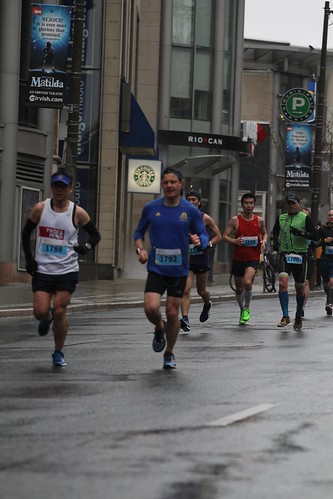
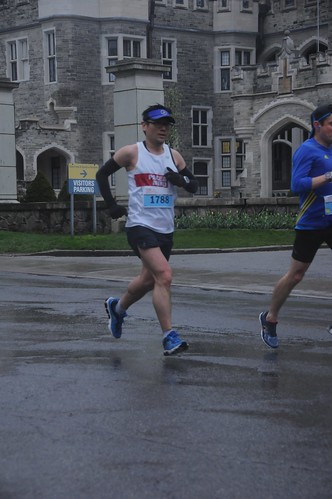
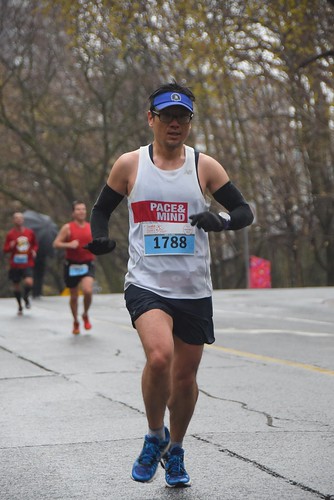
Not every mile is remarkable, but this one was. In a way, all miles should be remarkable.
Today's first mile was not unlike any of the past 999 days -- my legs were moving, my arms swinging and like most first miles, it feels anywhere from perfect to plodding.
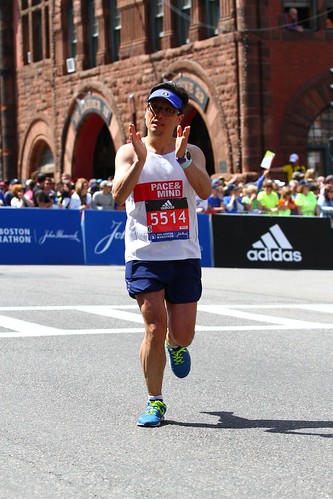
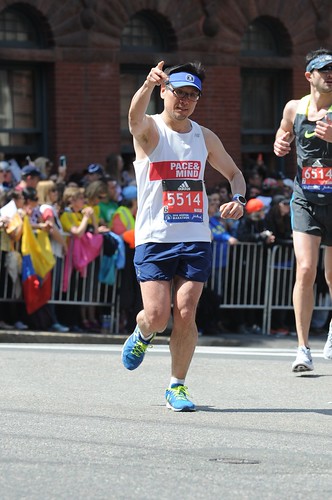
Today, for my 1,000th day of consecutive running, I marked the 1.61 km point with a tap to my heart with my right hand, as much as feasible in mid stride flying through to 1.62. I was running my fastest split. Of course I was.
This post isn't about the beautiful revelations you get by running every day. I've done that. This post is about skirting convention, about commitment, about longevity and about finding passions in your life and sticking to them.
***
In 2013, in a lot of ways, running saved me. I ran to get back my shape I had lost the prior two years. I ran away from the sadness of losing my mom and a long-time relationship. The miles through that year gave me a new sense of purpose that by the time I had hit November, I had rediscovered my love of faster running, and of racing. By the time I had done Chicago or, as I call it, The Comeback, I knew I wanted to kick up a gear.
By the end of 2013, I signed up with my now current coach and friend Rejean. I casually told him I just started a Runner's World run streak that started on Nov. 27. He shrugged his shoulders and as my first training plan, he had a run for me every day. Now we are here 1,000 days later.
***
I'm not sure what phase of the running boom we are in right now. I've read articles about how running has peaked past its second running boom ushered by the likes of Hal Higdon and John Bingham and lingered on with the formation of running blogs a decade ago, social media five years ago, and with club running and the more recent corporate sponsored movement propelled by the desire to reach young people and stamped by Nike, Reebok, New Balance. Now, running combats against spin classes, CrossFit, obstacle course challenges and bootcamp.
My 1,000 day running streak
Today, running can be about vanity, I have a view that running tends to be inward. No one runs your miles for you. No shoe, no logo, no hashtag will make any of that easier. The #nodaysoff movement I've seen pop up over the past year is measured by the easy/hard running conversation. Others talk about balancing running with other sports, finding ways of creating a more perfect athlete.
I got back into running to get back into performance. In these almost three years, I've logged 11003 kilometres (11 km a day average), run 20 races and seven marathons. I've thrown down five Boston qualifiers, run my fastest marathon at age 40. I've never felt better about running.
Running every day taught me that the outcome will not always about the pursuit of PRs. That drive can force you out of love with running. My 11 years of marathoning taught me it is easy to be overtrained, that life will at times will ask you to take away from the roads. Life happens, but so can running.
***
When I read about other streakers, those who been at it at jaw dropping amount, I see a possible path for me to follow. The path means that family, changes of jobs, life stages, other passions will inevitably come calling. When my mom was in her final year, I felt that call and I never regret releasing running for other things. Now, I know it's possible to fit in that mile.
That mile has meant early wakeups, 5 a.m. coffees, 6:05 a.m. run appointments with friends. That mile has meant repeats on a track or a hill or a progressively faster 35 km long run. That mile can be run solo or with a group of like minded individuals who cheer each other on. That mile has meant many new friendships, ones that probably wouldn't have been forced on this solo sport. For that, why would you not want to run every day.
Forcing myself out to get that mile every day has changed my life and my life outlook. I don't hesitate to push myself out the boundaries I set every day. I think it's possible to balance life, work, love, relationships, responsibilities.
My daily runs have transformed my days. I wake up early, I eat healthier, I feel stronger with more endurance, and I make that commitment. Unknown to me 999 days ago, I sleep so much better and that has been a huge benefit.
It may seem so minuscule, to put aside anywhere from 15 minutes to a few hours a day for your passion, but I meet so many people who love to cook, or get back into fitness, or write and read. They have aspirations and lists to fulfill. They have places they want to see and they want to do. I say, pick your passions, and do them. Time isn't fleeting but if you let slip a day away from the things you love, it will soon become two, or three, then you'll stop.
No matter what you goals are, or passions may be, you can't ignore them any longer, I have this one advice.
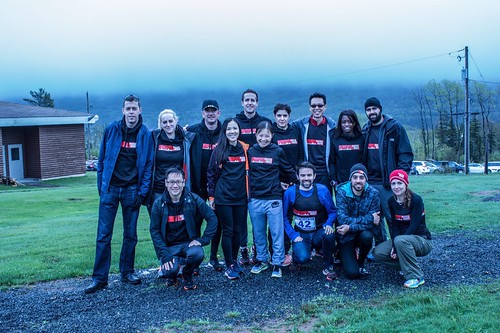
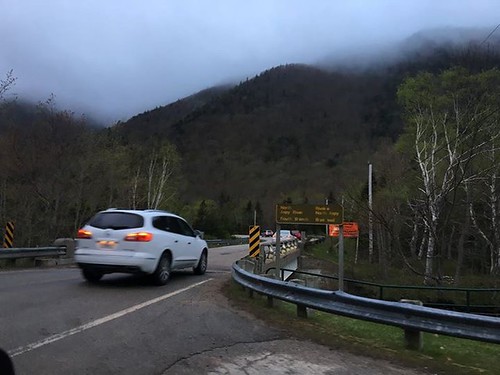
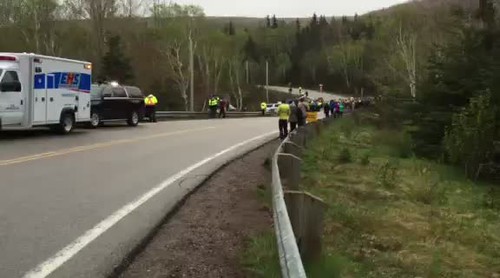
It started sometime after noon, a full 8 hours before I was to run my leg at the Cabot Trail Relay in Cape Breton. I was griping a rock found beneath a road barrier, and alongside my teammates, we pounded them against the railing, creating a rhythmic clanging sound. We watched my coach Rejean storm up Smokey Mountain for two kilometres, running full out at 5:15 kilometres.
We later watched him win leg 4 and as we were buzzing about that amazing performance, I was starting to dread my decision to sign up for leg 9. Nine was a killer. Nine was the hardest leg, apparently, of the 276 km Cabot Trail Relay.
Leg 9. How did I get into this?
***
Our Pace and Mind mixed team was lucky enough to get picked to be one of 70 teams to run this annual event, now in its 29th year. None of us had done the race before, but we all knew about this legendary road race. Starting at 7 am and ending more than 24 hours later, the relay departs Baddeck and loops the Cabot Trail. The course is jaw dropping, and the relay is organized as 17 separate races. We watched at one of the legs how the race organizers set up and tear down a finish/start line in no more than a few hours, only to head down 12-20 km down the road.
As first timers, just getting 15 runners and two support crew to Baddeck and then organized for the 24-hour event meant that running and strategy fell to the wayside. Our team was made up of distance runners, most of us marathoners, and most of us were past our goal races, ranging from Boston in late April to Mississauga in early May.
Photo: Pace and Mind
As the day went on, I couldn't helped but be awed at the scope of the distance we'd be travelling. As we went down the course, little bumps on the course maps were genuine hills. The big climbs, like in Rejean leg and later Ivy's leg 7, showed that there was a monster lurking. That monster had a number on it.
***
I first heard of leg 9 when I started hearing about Cabot. My friend Jules had raced leg 9 a few years ago. I remember that because she described the uphill and the quad-thrashing downhill. She had said she'd never seen faster splits ever appear on her Garmin. She described running nearly uncontrollably down that mountain.
I mean, just look at it.
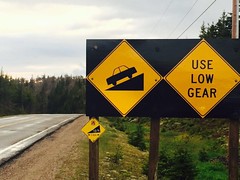
The winding road climbs 6.2km from around 40 metres in elevation up to 446 metres, followed by a few more climbs. Then it pretty much plunges all the way down for 6 kilometres, followed by a final 5km of rollers.
In sheer height, the 464 total metres of climbing North Mountain in leg 9 is higher than the Empire State Building or the top of the observation deck of the CN Tower (where Drake is famously perched).
Holy cow.
Sounds like fun.
Sign me up, coach.
***
Photo: Aaron Barter
I arrived at the start of my leg about an hour before the race. We had a three-car convoy with one car as support (picking up runners) and the other two on the way to the next leg or just supporting and cheering on the course. The beauty of it is we could see all the legs before ours and get a sense of the course.
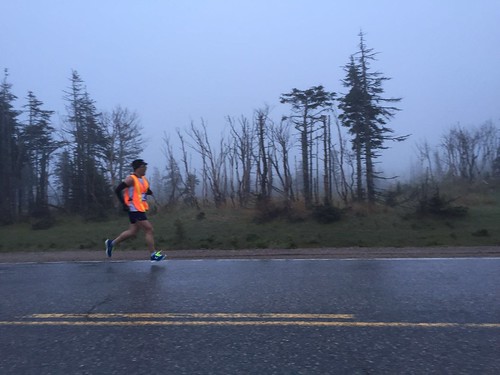
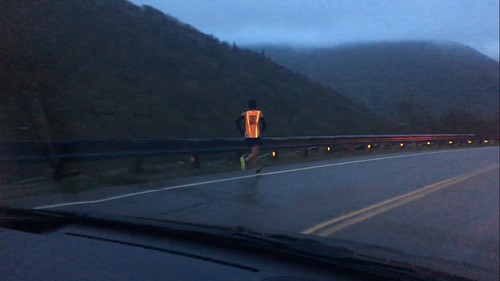
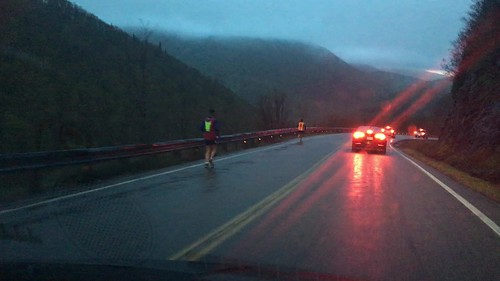
Leg 9 starts off at the base of North Mountain, which means you can see it looming in front of you. It also means that you start to immediately climb it for 6.2km. Because the leg was the first 'night leg', I was to wear a safety vest and also have a headlight. It was likely that I would finish the race as darkness was falling but the light would make me visible.
The temperatures during the relay varied from warm to misty and straight-out cold as we faced ocean breezes. As it was misting when I arrived, I opted for a double singlet, the vest, shorts and arm warmers/gloves. There were three water stops during this 17.8km leg.
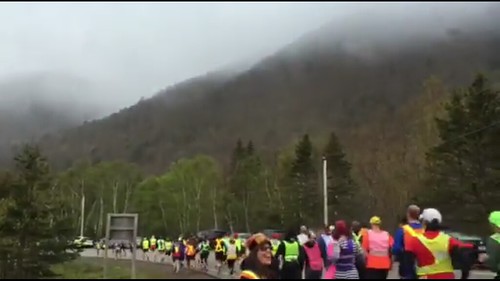
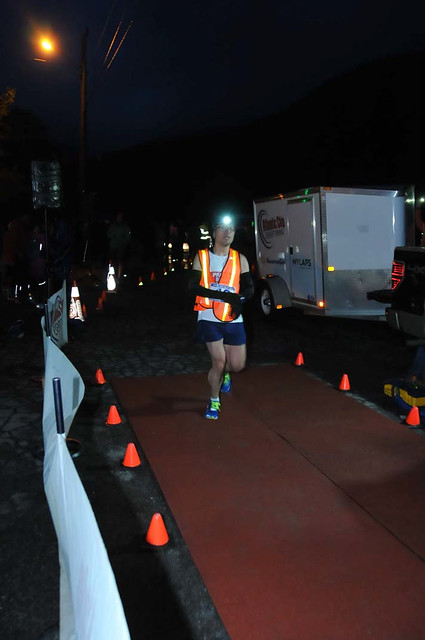
I watched Caroline finish the leg on a thrilling steep downhill, followed by an 8 metre finishing chute. By 7:55 pm, we were beckoned to block the road, given quick instructions, and promptly told to start
The mountain
Thing is, I'm still never sure if I'm actually good at climbing hills, but not for the effort or training. In my leadup to Boston, I had trained for hills but even that 42.2km course is not nearly as hilly as leg 9 (150 m vs. 464 m). In the weeks leading up to Cabot, I was only doing maintenance mileage and throwing in my weekly spin classes, where I would do most of the 'hill climbs' out of the saddle with no rest. I knew it would be nothing in comparison to 32-34 minutes of continuous climbing
Video: Andrew Young
The first two kilometres were done a bit faster (4:25 and 4:58) but represented not as steep climbs (35 metres and 47 metres). The field quickly separated and I was a little bit surprised to see about 16 runners spread out ahead of me, some in the far distance. Cabot has a huge spread of really fast runners and I knew i'd be mid-front pack but some runners were just hammering the hills.
My strategy was to acknowledge that I would have to run by feel -- that 32 minutes of climbing could see me red line. As I hit the third kilometre and saw the seemingly neverending hill, I knew I had a long ways to go. By then, I dipped to a 5:26 kilometre with a climb of 80 metres. I could feel the redline coming, so I slowed so a runner behind me could go ahead. My thought at that point was this was a three part race -- climb, drop, rolling. Little did I know there was a fourth I hadn't quite anticipated.
The fourth kilometre shook me, not only for the 62 metres I climbed and seeing the pace drop to 6:26 km, but I could see the winding road ahead of me. My breathing didn't feel right so I did a few walk breaks, thinking I could make up that time on the downhill. Number five, at a whopping 142 metres, was a doozy -- 7:22 kilometre. It pretty much felt like I was climbing stairs at this point.
Things improved as I started to crest. I knew I wasn't overdressed and was ready to get the legs moving. The hill, which I'll never soon forget, was completed with a 5:35 km.
So I got my legs underneath me, and I focus was to use the flats to get some pace back. I wanted to get the wheels turning, to turn up the cardio effort back to a comfortably hard notion. It helped that there were some cheer stations at this point so I was able to do a kilometre in 4:08, even with a slow rise.
Photo: Pace and Mind
But, of course, there really is no big flat sections on this leg as I could see the cars ahead of me fall, then rise. Another hill, which I was able to navigate at 4:38. I knew this next section was coming fast, and I would have to figure out how my legs would deal with that plunge.
Splits: 4:08 (+7m), 4:38 (+25m/-15m)
The downhill
A friend of mine who navigated leg 9 told me to expect to run almost uncontrollably. You were literally thrown down a hill, and with every step, you had built momentum. Downhill running works well if you know how to run them. Get your legs underneath you, lean as much into the hill, and leg the gravity and momentum do the trick.
I'm a high-cadence runner, which is to say that my wheels turn over very fast. I can go 200 steps per minute without real effort. As for downhill running, this helps get my legs down on the ground even as it continues to come up at you.
All runners, though, are going to get the quads thrashed in this manner and even so, it will pound. For 3,600 steps, I would be hurtling down.
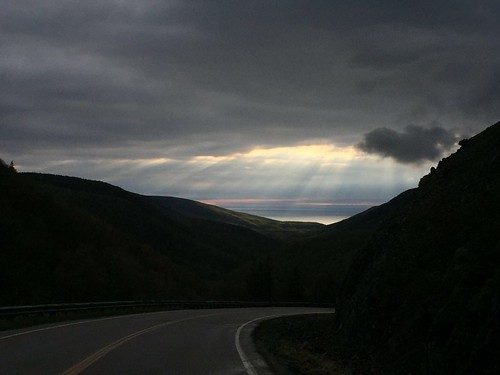
With the winding road, I just let the course dictate the next step. I knew there were spectacular views, but my eyes were firmly focused on where I though the next two to three steps would lay.
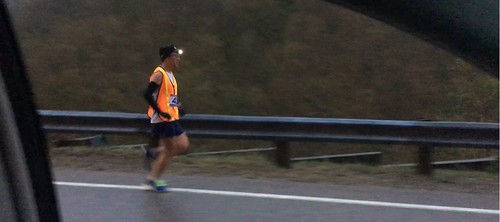
My teammates caught up to me at this point and you can see me running down that hill, high cadence, focus on the road.
I ran a 3:55 km, then as I started to plunge, I hit a 3:32, 3:30, 3:35 for three straight kilometres.
It didn't feel like a massive cardio effort, but I was spending a lot of time pounding down that hill, my legs absorbing all that shock. I finished off the hill with a 3:58 as the course flattened out.
As I finished the, I glanced at my watch and I could see that I had just ticked by the 13 km mark.
Oh great, more than four more kilometres, and it was anything but flat.
I sometimes rerun a race in my head and this is probably the portion that I would ask myself for a do-over. I hit the first kilometre in 4:19, which is somewhere between half and full marathon pace. I willed my legs to have better turnover but I could already feel the pounding of my quads were not helping my running at all.
I wish I remembered I had a gel with me, because I probably could have used some sort of a boost. And by the way, since I passed one runner on my way down the hill, there was NO ONE I could see ahead of me. It was pretty stunning how the field could spread. I had no one to chase down, no one to measure my effort against.
It was a ghostly view of a sunset against a horizon of mountain peaks. It was a little spooky, so much so that a puddle of water ahead 50 metres prior was some sort of small animal. Was my lack of sleep the past few days catching up? Had I lost the race pace I usually know well?
In any case, a 4:26, 4:30 and 4:37 were not the types of splits I wanted to see at the end of a 17.8 km race. I know at peak fitness that I could have been 15-20 seconds faster.
In the distance, I could see another big hill in front of me, and the glow of neon sicks that served as directional lights. I climbed the hill towards the finish, which is a fast right hand turn directly into a parking lot of a restaurant.
I was finished. 1:22:56, good for 18th place out of 70.
I feel funny writing a race report because for me, leg 9 was just one of the small pieces of an epic weekend. By the end of the relay, we had raced 276 km and came in sixth overall, second in the mixed division. I'm so proud of that, moreso from the fact that everyone gave their all, everyone helped one another. My team, which I already think has an amazing bond as I've run hundreds, even thousands of kilometres with these folks, bonded as a unit even more so in the ramp up to the race and in the afternoon and evenings after where we talked about the amazing weekend where we ran a dream race.
From all indications, the organizers liked our energy, spirit, teamwork. We hope that means we'll be back sooner rather than later.
Cabot is so much more about one race, but a weekend spent doing the best sport in the best way -- with other people passionate about it. I'll be living off the highs of this event for a while yet.
Nine days ago, a day after I got back from Boston, my quads still stinging, my hamstrings sore and my spirit undiminished, I sent my coach Rejean an email with the subject line: "Update and an audacious plan?"
A few days later, my friend Lee, sent me an email titled "My latest crazy idea."
The night after the Boston Marathon, Lee and I commiserated about the day that was not ours. It was too hot, too sunny and just not ideal after a winter of training. Lee was thinking that he'd love to make it back to Boston next year. I was lamenting a strong season of training that resulted in only two races. Over three dollar drafts of PBR, we drowned our sorrows, quietly hatching plans.
I suppose there's something in the water in Boston.
***
Goodlife was 13 days after Boston. And as I saw the forecast shape up, it looked like an ideal forecast. Cool. Like good cool. So I asked Rejean whether he thought I should go for it. I reasoned my Boston, run in 3:23, didn't see me entirely empty the tank. Running 42.2K 13 days out isn't common, but it can be done. We worked on a workout plan to see how my legs were bouncing back.
So over the past week, I threw in a medium run, a few quicker workouts. I was tired, I was sore, but I knew I was still fit. My goal, I presented to Rejean, was to get to 3:10 or faster, which I thought was well within my aerobic capability. And also a good shot at a BQ, which for my age is 3:15. Rej hatched a sensible plan and Lee was on board to run with me as long as we could.
By the time I was making my way to the race start, only five people knew I was racing.
Codenamed Project Audacity.
***
1K-5K
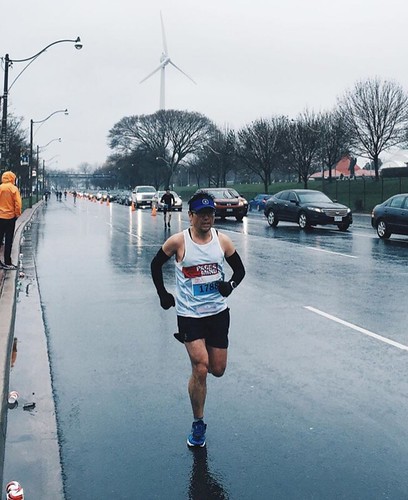
Of course, this seems to be the year where weather throws some challenges at you. It was a light rain, lots of wind and it was cool. Lee and I started together and just ran by feel, mainly. The course takes a north turn where we were able to get a sense of the wind (North East) but we were able to plunge down Yonge Street. We've both run Goodlife on numerous times so we knew what to expect. A big downhill before Hogg's Hollow. We did that split in 4:30 km.
Splits: (4:22, 4:29, 4:28, 4:11, 4:30)
5K-12K
I took a kilometre or two to settle down from Hogg's and I was paying close attention to how my body was responding. To me, the effort felt slightly harder than it should -- i'll take it as fatigue following Boston but when I compare it to my course feel at Boston, this run was way better. I was wearing a double singlet, a visor, arm warmers, gloves and shorts. All were great ideas. I felt I was cool enough, but not risking of hypothermic. I wouldn't sweat too much which would have been my major worry. As well, the stride I was running felt efficient. I was taking careful notice of my left calf which was what seized at Boston and hoped that taking in Gatorade and gels would delay any issues.
The course has a bunch of rollers, then turns around Davisville where you wind your way around UCC. We felt the tailwind for the first time and it was glorious, so we kind of let the feel dictate the pace. By the time we hit 14K I knew we were banking big time with the faster downhill splits.
The Casa Loma to the bottom of Rosedale Valley is what makes Goodlife a fast marathon. You can run it and bank time but also save your cardio. We hammered it where we could but while running down Rosedale Valley Road you could feel the headwind running east. It was noticable, even with the trees as cover.
We ran down Bayview extension and the pace still felt good. Saw my teammate Bart who took this picture and we just kept on chugging.
Lee and I hauling ass.
We hit the half mark at 1:33:22, which was a 3:06:44 pace. We both kinda knew that we'd probably be giving up some of that time so I told Lee I would regulate the pace a bit.
22K - 35K
This section is what I call the 'home course' all the way from Corktown past to Humber Bridge, along the MGT. This year, we had a nice tail wind, sometimes a crosswind, and if we had buildings ahead the wind would bounce off and push us. In all, I was able to bank effort while using the aid to save some energy. As I was hitting the 24K mark, I felt that today, barring wind, I would be able to power through the 30-35K mark with strength.
We entered Ontario Place and out on the trail and Lee then went ahead. I decided not to give chase. In retrospect, maybe I should have taken advantage of the wind and done a stronger run up to 35K but I just was content zeroing in on runners around me. My gloves were soaked, my glasses were fogging up and covered with droplets but at least I was cool. Today I felt I would go for it.
The 3:10 pacer caught me at 35K tearing around me with a big group. I thought they were going fast so I didn't give chase but I wish I had -- they would have been a good wind block in future miles.
So as we turned back, we were hit with a wall of wind. I can't even describe it but it felt you had a parachute attached to you. I run on the waterfront often and this I would call an exceptionally windy day. I felt my pace suddenly drop. Breathing was hard. And lo and behold, the left calf was strarting to show signs of cramping.
Once we got past a particularly windy section and hit the bridge the wind wasn't as bad -- though horrible, and I forced myself to pick up the pace.
Each kilometre became a negotiation. I was frustrated that my effort was not turning into turnover and speed. I fought impulses to slow down to walk. As each kilometre came (38, 39) I was looking at my watch thinking of all the banked time that was now coming back to me. I knew that if I hit the 40K mark in 3:00 that I could probably hit the 3:10 target.
If only two kilometres could be so easy.
I asked myself if I could run two kilometres. I thought about the marathon and how I committed myself not to run one this fall. This was it. This was my chance to put it in. Taking walk breaks would slow me down, but just keeping my movement on would push me closer to the end. I found a second wind in the final two. It was hard, I won't lie. Running two marathons at effort in two weeks is something I haven't done in awhile. But I saw friends, the crowd and realized that if I just pushed for a few minutes, it would be a difference between hitting 3:10 and a 3:13. It would be the difference of qualifying for Boston with 1 minute of buffer and a lot more than that.
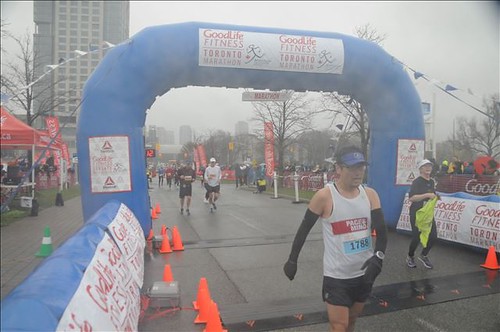
So I pushed. And hit the final corner with a great crowd cheering.
The final stretch. Photo: NightTerrors
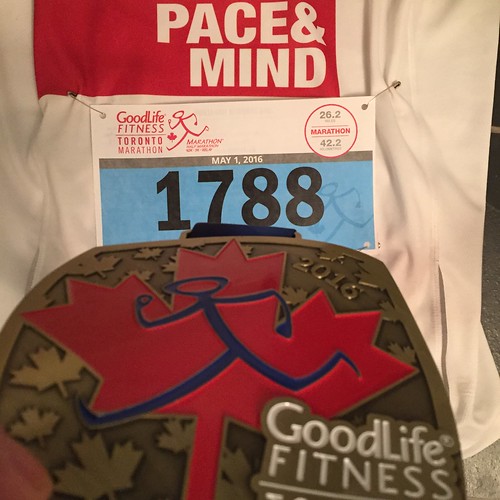
I looked down at my watch and laughed. 3:11:00 by my hand. 3:10:59 chip. A 4:01 under my Boston Qualifying time.
I quickly caught Lee at the end. He hit 3:10:15, and also a big BQ for him as well.
I've run faster and I've closed races much stronger, but of my 33 marathons, this was one I'm proud to have run. Would I suggest runners try a 'revenge' or 'redemption' race so close to after the one they went wrong. It's probably not for everyone. And it's probably why I've been keeping this under wraps.
But for sheer audaciousness? Absolutely, sometimes, it has to be done.
There are moments in your life you want to freeze frame. I've had them, far fewer than I would have thought in my 40-plus years on this Earth. Full awareness when you are living in the moment. Seeing a beautiful landscape that your camera can't capture. Watching your favourite band or sports team. Seeing your Dad content at the end of the meal.
I've had quite a few moments in my life on that 26.2 mile stretch of road between Hopkinton, Massachusetts and Boston's downtown. I savour those memories.
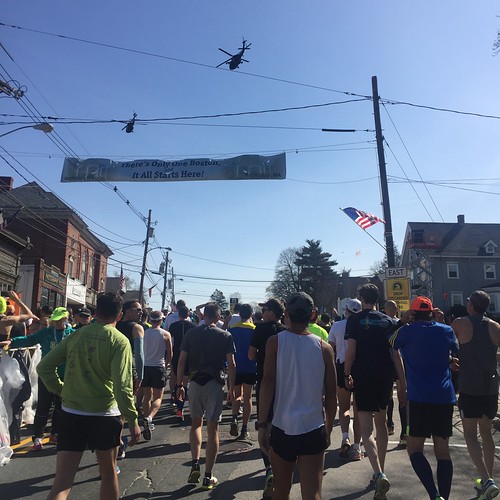
In 2011, the second time I ran Boston, I stood in my corral and amidst the chaos of the pre-race start. It was the anthem, runners hurrying to their corrals with moments to spare, a helicopter overhead, and the slowly advancing mass of some of the finest marathoners on this Earth. I remember smiling to myself and thinking that was a lifetime moment. Appreciate this, I told myself back then, you may never be back.
Yesterday I put in the effort and while the result isn't what I wanted, I've got another memory for a lifetime.
***
I flew into Boston knowing that I had a solid season of training behind me, with little racing to prove much. Last fall's cycle wasn't the greatest for me -- work was busy, and my quality and long training suffered, which I saw in a sub-par half marathon and a disappointing Philly.
By January, I was hungry again for Boston and added back spin to my weekly routine. Each week had me doing four quality workouts, from tempos to longs and I was able to hit plus 100 km weeks often, with four 35 km runs in the bank. Around the Bay as a training run two weeks out was a confidence booster. I was fit, I dropped some pounds to a good racing weight and aside from some niggles, I was feeling good.
The Thursday before Boston, I was not liking the weather forecast. It was calling for 22C of a high for Monday. By the time I was in Boston on Saturday, the weather was cooling somewhat but it looked like not to be ideal.
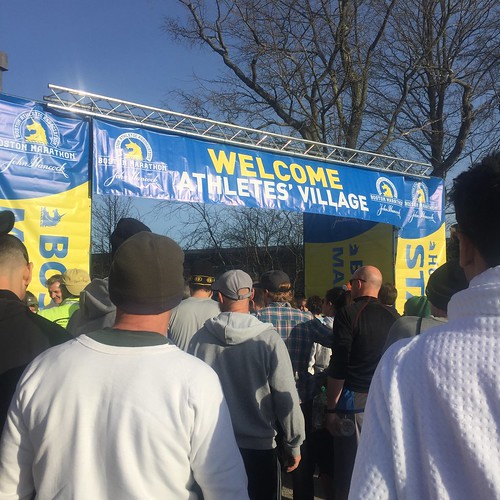
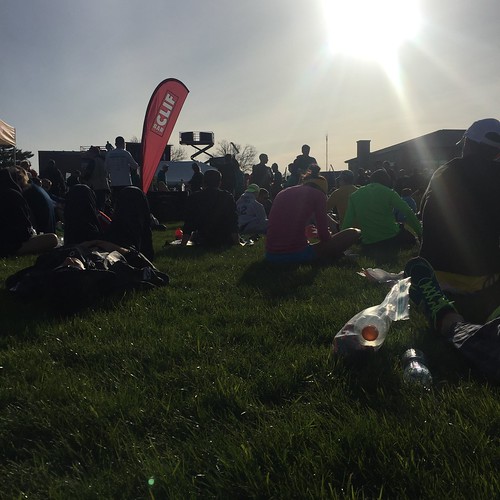
I took the trip up Hopkinton on race morning with my friend Lee. And an hour later while waiting in the village we knew it would be a warm day.
Facebook Live video walking to the start
The race
5k (0:22:25)
I decided to start with the race plan and adjust as I felt the air temperature. With my corral, it was easy to maintain a fluid pace, hitting 4:22s to 4:30s in that first bit with the mostly downhill portions. I was running in shorts and singlet for the first time in six months and though that felt freeing, the sunlight on my bare arms was instantly heating me. I run the best in around the 8C to 13C range -- my best races in fact have been colder than 8C. Hopkinton at 10 am was 18C and quickly warming.
The overall race plan if the weather was ideal was to look at 4:25s to get me to a sub 3:07 finish. Even after a few kilometres, that looked not to be in the plan as even the downhill I held back. I was trying to feel the air temp and try to regulate my effort so I could slowly warm up. I did the first 5K pretty much dead on 4:29km pace which I was 100% fine with at that point
10k (0:44:49)
I'll note that the day was amazing for spectating. The crowds were out in full force and it was so great to see the state come out for this race as it does year after year. When you're racing Boston, you don't have as much of a chance to enjoy this as you're working toward your pace. We worked into Ashland and into Framingham. I distinctly remember passing the train station at Framingham reflecting on the amount of effort my pace was taking on me compared with last year's effort. It felt a lot more forced to run at pace and that was not a good sign. I was seeking the very little shade there was on the course on the right, when it was there.
15k (1:07:16)
Past Framingham and into Natick, my pace was still right on 4:29 km pace. Around that time, the air temperature for Natick was at 23C. It was at this point where I knew that the 'easy, easy, easy' rule of the first half of the marathon was not coming to light. I was working harder than I should, and I knew it was not going to be a good second half. By then, I knew that after Wellesley and into the Newton hills, I'd have to negotiate them and not redline too early. I'd let the next 5km dictate the second half of the race.
20k (1:30:34)
Running into Wellesley marks an important part of the marathon course. You should be finding your cruise pace, a pace you'd have to recall 15K later when you crest Heartbreak Hill. It also marks the Wellesley Scream Tunnel, that ear-piercing line of college students with hilarious signs, a sure-fire way to get your pace going. I hit that portion not mentally there as I have in the past three Bostons. The pace was hard work enough.
Half (1:35:36)
I hit the half with an overall pace of 4:31 km. Coach asked me on a warmer day to adjust my pace by 5 seconds and it looked like I was going with that rule. Last year I hit this point in 1:32 on my way to a 3:07 Boston. Nope. Not this year.
25k (1:53:57)
I switched to my new pacing plan: Settle down to 4:40s or so for a while and see how I would navigate the Newton hills. In a weird sort of way, settling down the pace felt like I was gearing down big way. My cardio engine wasn't firing as high and I think that's what probably saved me down the stretch from overheating. I averaged those splits down to 4:40s (some faster, some slower) and it looked like a lot of other runners were doing the same around me. At some point, I jammed my left foot against another runner's heels when he slowed down at a water stop. In a kilometre or so, I could feel it throbbing and I knew I just developed a blister. Great.
30k (2:18)
Oh Newton, how fantastic are you. I'll save all the drama as to say that I ran all of the hills. Not powerfully as I could of. By then, my left calf was showing some tinges and the toe that I struck earlier was forming a blister. I couldn't get a proper toe off. But I took the measure of each hill and just put my head down and did them. Heartbreak really isn't the steepest hill there is -- it's long, though, and at the point of the race where you'd rather not have one.
35k (2:43:38)
Cresting Heartbreak is an energy boost as you get to enter Boston College where the spectators are usually loud as hell. You're also treated to a nice downhill. I tried to turn it on but it wasn't happening. The cooler headwind wasn't working its magic. By then, I figured my goal was down the tubes and the legs were on the verge of seizing. At that point, I knew I didn't have the race in me. The crowds were growing and I was appreciating the moment, in whatever state I was in at the time. Tired. A little overheated. Cramping. I wanted to enjoy it more but I also wanted to put some effort into it.
40k (3:10:05)
The last two kilometres the leg cramps were coming often and with greater strength. I would have to stop and stretch lest have them seize on me. And so that's how I finished the final stretch of the Boston Marathon. Slowly, with forcing myself to jog it in. It was an odd feeling, almost as if I were outside myself, watching myself slow down. But it was fine. I had survived a hot marathon intact, with only sore quads, aching calves and a blistering toe with a developing sun tan. I smiled a lot in that final mile.
I hit the finish line as slowly as I could, eventually hitting it in 3:23:03. I knew it would not be a finish line I'd see next year. And, given where life priorities go, maybe not the year after that. I thought back to the day, and of all the days that led to the last four Bostons. I fought to get here. When I said goodbye in Hopkinton in 2011, never would I imagine I would be toeing the line five years later a stronger runner.
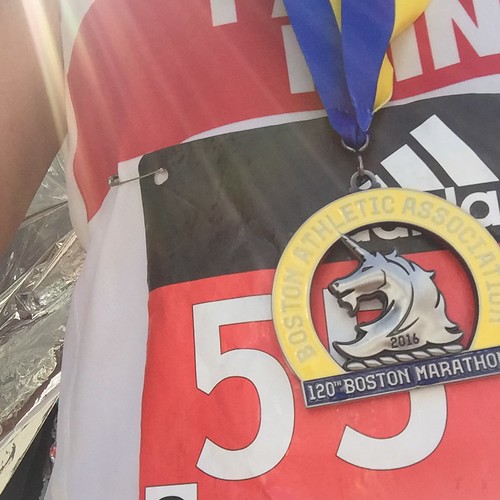
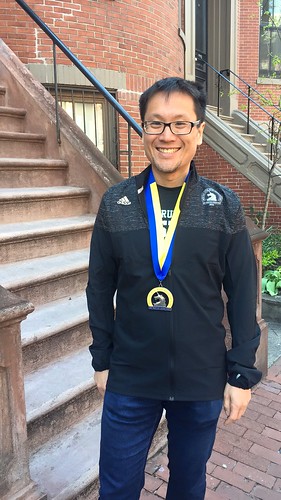
And so I left satisfied. Happy. And fully aware of the moment. I got to do my dream marathon yet again. Four times to Boston, four medals, and four lifetime experiences I will always cherish.
Will I be back? I hope so, but I know that famous route from Hopkinton to Boston is a course of dreams for thousands, including many of my friends. I want them to run it so we can talk about finding your dreams. That's what I take away from Boston. A full appreciation. Thank you, Boston, its volunteers and the fellow runners who bring their passion to these streets. No matter if I'm back or not, I have a chock full of moments to remember for a lifetime.
They are moments of quiet, those resting seconds before the next lap, when your body is settling down from a near-heaving state that breathing almost feels normal. Instead of panic, you feel calmness and as your stride cadence picks up, you hit the lap button, and then it begins. The work is ahead of you. Time or distance, there is something you're counting down to or running up towards before your next round, before the next rest.
The resting period between intense efforts is how we actually define intervals. We aim for consistency as we hit each one, even generating more power as we hit the final sets.
The rest period is a body reset. It shields you from red lining, while helping you create bulwarks, those fortifications against fatigue.
Sometimes, the rest period lasts for a minute or two. This pause I've taken here has been necessary. But, as with all running, you have to start again.
Last year, after running Boston, I felt that I needed a reset. I had just put two of the most intense years of training behind me and was a stronger runner at 41 than I was at 30 when I took up long distance running. The summer, I went through the motions, but nothing was firing properly. That interval of time taught me a lot of lessons. By end of the year, after a dismal Philadelphia Marathon, I felt like I took enough of a pause. I was ready to hit restart.
In the interim months, I've rebuilt myself. I took up spin again, I hit the track, didn't miss a quality workout, reconciled what my schedule and work and life priorities could make room for my running. I battled through two colds, showed up to practice and trusted that I could peak at the right time.
Running is not as simple as you think it is, and a lifetime spent running only presents you with unexpected turns. We talk about the rush of improvement, the attainment of goals or lowering times, the serenity that you look to return to. We relish the alone time in this never pausing world, yet flock to the groups that give us community.
The laps we run and the intervals we take -- measured in kilometres or time -- slowly start to become much longer markers. Weekly mileage, monthly buildups, seasonal cycles and race calendars. In between the laps come moments of exhaustion and exhilaration, a neat combination that you may feel on the couch after that penultimate marathon training long run.
The most euphoric moments of running -- often happening at the end of a gut-busting workout or moments after you let the newly acquired hardware dangle from your neck -- can lead to the next natural yet opposing thought. What's next?
It's not lost on me that 10 years ago, I was training for my first marathon and in a little more than two weeks, I'm running by 32nd. What gave you motivation for the next run in your first 1,000 miles is a world of difference 10,000 miles later.
And when those intervals drag out, it give us pause for reflection. When us runners deal with aging, with hitting training plateaus, or just finding ourselves with life and or other passions demanding attention, just as the run does, it's easy to put that interval between laps in the rearview mirror.
The period of rest gives me perspective and as my run streak approaches 850 days, I've come to the conclusion that I want to run long, and for a long time. I want to run fast, but within the limitations of what a reasonable mid-pack runner can achieve when life beckons. What I love most about running is that it gives back what you put back in, and right now I'm good putting in the work.
The fire, I felt it in those final miles of the Philadelphia Marathon this past weekend. It was burning in my legs, that tinge to signal effort. It was present in my lungs and I could feel it in my veins.
This morning, five days into my off season, I woke up before my 5 a.m. alarm. I balanced a mug on my lap as I warmed to the thought of the outside. In another half hour, I was outside to confront November, running as darkness reluctantly relinquishes control. On a similar morning, four months ago, I'd be on my front stoop, stretching lightly, babying a niggle on my left hamstring, watching the mid-summer dawn take over the sky. Eight months ago, I was watching the late winter give way to spring.
Today felt like spring. Today was like first day, only that it wasn't.
Run, every day.
The first few steps of every run reignites everything. It may draw out your pains, may expose your lack of sleep or express how fit you truly are. For the past 730 days, I've taken those first steps and it's led me here to this moment.
I'm writing this as I "lap" the second year mark of my run streak. Last year, I wrote a post about the things I've learned about running 365 days, and although not much has changed, my perspective is evolving.
The life of a runner begins with enthusiasm, sparked by fitness gains and early PBs. They're bolstered by bucket list goals, by friends we meet on the trails and the goals we dangle in front of us. Over the years, that early love affair with running changes, not as obvious as a fork in the trail, but there is a point in the path where we decide what running is to us. Is it something we did before life and work and responsibility edges out running.
I've lost count of the number of kilometres or runs I've accumulated in the past 11 years as a long distance runner. Two years ago, in starting this run streak, I had rekindled my love of performance running. Simply, I wanted to get fit again, get as fast as I could, and get to Boston. Within those two years, I achieved that and more, but the unintended outcome -- in its 730th day -- was the unexpected surprise.
Heat map of the last two years of running
That fire I felt in Philly was another rekindling. I was reminded that running in the long term is not unlike every stride you take. Your next step follows the first. You bound through trails, on top of concrete on asphalt on a forward motion -- jumping, really -- that would not have been possible if you hadn't taken the step before that.
We bound, one foot in front of the other, on our daily runs. Over the course of the days and miles and trials, we get stronger. That strength is like a shockwave that travels from your heel right up to your heart. A runner's body changes over the course of the years. Our bones solidify, our muscles extend and tighten, our bodies can get lean, our stride efficiency increases.
There are moments during every run when everything feels fluid. Easy even. But that belies the pain -- forcing legs to move faster than they are capable, pushing the heart to pump out enough oxygen to fuel your needs.
In the middle or end of any hard workout there is a point when you say no more. You think you can't go forward. But you push. And at the end, lungs busting, heart leaping, knee leaning, you are crafting a harder version of yourself.
So I enter into a part of my running life not thinking that the road has run out, but rather that I've taken that brief pause, and now I'm ready to see where the next cycle will take me.
Run streaks are really not about peering from the top of the mountain to appreciate the view, as there is no summit. You're in perpetual motion. Every day resets itself. You get on your shoes and, like any other runner tackling that day, you're taking your first steps. Something fuels that. Ritual, repetition, for sure, and maybe even habit, but I think somewhere in there you need the fire.
They say you don't want to run another marathon until you've forgotten the last one you've run. The pain you experience during those challenging miles, the wall, the cramps, the feeling of exhaustion meted out, drawn out. Why do we do it again?
In those final miles of Philly, a race that didn't go according to plan, I told myself to fight through. I shut any impulse to shut down. For once in the past few months, I embraced the suck.
And when I passed that finish line, I felt a different type of fire. It continues to burn.
There comes that point in a run where you get to the stop light. You linger, waiting for the seconds to count down before you have to start up again. Your heart rate comes down, you can almost reset your systems before continuing.
Sometimes, I run toward the stop light, hoping for a pause.
This post is about interludes, about training and a little about what I've been up to these last six months.
I found myself at the end of my last marathon with the prospect of yet another summer of training, ramping up, getting the miles in, the quality work building a better me. Yet at the same time, I felt the tiredness that had started to set in with a busy work schedule, other priorities and found my time crunched.
How do we rebalance a life of a runner when priorities change? I've thought a lot about the quality of my training, the amount of time I put into it and even how much I spent time writing in this space.
This year marks the 10th year I've trained for the marathon. After running my 30th at Boston, I felt that I'd come full circle -- I was faster than I've ever been and it was an amazing accomplishment but not without the toll. I had niggles that persist to this day, was losing out on sleep and started to see training as work, not play.
Signing up for a November marathon pushed out my training well into the summer, yet I was still doing long runs in June and July. And as the early fall race season hit and my friends started their off season, I felt I had prolonged things too much. So I enter November and my prep for Philly wishing I was in the off season. My fitness tells me I can do this marathon, even at a reasonable pace, but not where I was earlier this year. I welcome the off season and am hungry to get back at it next season.
The pause, or interlude, is something that I desperately need. One can not keep the pace season after season, I've learned, and if I'm going to look at having more years of strong running, I'll have to learn how to reassess, rebuild and capture that feeling of performance running. That, and refocus back on strength, diet and training consistency.
One thing that is consistent is The Streak: I'm now 711 days into the running streak and it has transformed my running life. As I look forward to finishing the second year of the streak, a few things that have come apparent. I'm a morning runner, able to wake up at 5 am with little fuss. I'm an early sleeper as the body has naturally adjusted to the wakeup calls. My easy runs are truly easy and I listen to the body with every run. I feel connected to the process to the point that running every day is not something planned, but just done.
So what's coming up next is another race in two weeks, another off season and the healing and ramping up that will happen with my 2016 marathon, which will be the Boston Marathon. I'm not sure if I'll do a marathon next fall but there are different races, reasons to train. I look forward to getting my body and mind into that process. I'll find more to write about running in that journey. I'm back, but in essence, never really went away. If you want to follow my runs and pictures I share, I'm on Strava and on Instagram.
There are markers we aspire to meet, lifelong goals runners use as benchmarks. For me, aside from the Boston Qualifying times, it's been the sub-20 5K, the sub-40 10K and the sub 1:30 half marathon.
The 10K and 5Ks are not my favourite distance. The 5K amounts to about 20 minutes of sheer pain, the only comfort around the first 200 metres, cresting at the 3.5K mark when you try to hold on to dear life. The 10K is no different, but with prolonged hurt. Hurt is assumed with both, while at the half marathon or longer distances, you can just try to reach a comfortably hard mark. Make no mistake, marathons hurt after 30K, it's just a different type.
I've come close to the sub-40 mark for the 10K a few times, first in 2009 while ramping up for a spring marathon, when I hit a 40:04 on the downhill Sporting Life. I would largely avoid 10K races until last fall, when I hit a 40:07 mark at the Zoo Run, a much harder course. In truth, my training had me with a fitness for a low to mid 39 minute 10K but when the marathon is your distance, you don't put much into such goal races.
In late January, I toed the line at the MEC 5K as my training for Boston was ramping up. It was a brutally cold windy day and I hit a 19:42 with splits of 3:45, 3:58, 3:53, 3:56, 4:04, not the greatest way to pace a 5K. I knew it wasn't the indicator for my fitness and decided to race the 5K again before Boston to see how I would fare.
In mid March, I ran the Achilles 5K, hitting a personal best of 19:07 on another windy day, with splits of 3:49, 3:55, 3:35, 3:49, 3:42.
The Achilles was a good sign in seeing whether I could sustain a 3:50 pace, which from training I knew I could.
The 10 K
Fast forward to Sporting Life 10, which took place three weeks after Boston. I had a week earlier done some faster kilometres in training but nothing close to the sub 4:00 kilometres. The legs were still recovering but I felt I still had cardio power in me.
I met up with a few of my friends and teammates, and found myself in the red corral, the sub 45 minute crew. A few of my friends were also aiming to go out at a sub-40 pace, or at least try for a sub-20 5K and see how it went.
Sporting Life is a fast course, due to the plunging downhills of the first half. There are some risers, but when the weather is perfectly cool as can be in May, it an produce stellar times.
So I went for it.
First 5K
But there was the weather -- we could feel it at the start, it was comfortable, not cold, or yet warm, but concerning. I like to be shivering for races so as I increase the effort, the cooler weather will let me build up heat.
As I thought, the first bit felt easy, too easy. So I tried to let my breathing and effort guide my cadence. My legs had not gone this fast for almost a month, so it was a little bit of a shock. My friends Cynthia and Joel were ahead of me even though they were aiming for a 19:45 5K, so I just let them go and see how my effort would take me. I hit the first kilometre in 3:49, a little faster than the 3:55.
So warm out. Photo: Michael Lin
Take advantage of the downhill, coach Rejean asked me to to, so I wasn't to concerned when the second kilometre came in at 3:52. We hit an uphill portion at Mt. Pleasant cemetery and still my pace was feeling comfortable. We had shade still from the rising sun and though it wasn't comfortably cool, I wasn't overheating, yet.
I wanted to get to the 5K mark in good shape to stay consistent for the end -- I knew the real battle would happen around 7 to 8K in, so I stayed relaxed as much as my body would let me.
I hit the 5K mark in 19:07.
Splits: 3:49, 3:52, 3:51, 3:43, 3:49
Second 5K
So by the beginning of the sixth kilometre, I knew it would be a challenging run. It was getting hot. My breath wasn't as even as I wanted. I was waiting desperately for the water stations so I could get some liquids.
My 6K, as it turns out, was my last sub-4:00 kilometre, hitting it at 3:47. I was feeling pretty crap, and tried to get my body to now run closer to 4:00s, but it would really cooperate. I hit a water station and took a cup to drink, a cup for my arms and a final one for my head. It was that hot.
The next kilometre came in at 4:05, and the next one, I took a 10-second walk break. I knew my body wouldn't sustain the searing first half so I'd have to be content with cooling off, then revving back into some sort of low 4:00s. I knew I had a bit of a bank for a sub-40 but I could lose all of it in one kilometre.
In the final 2K, I stopped again, only to be spurred on by a runner who passed me and said I could do it -- so I brought back the cadence.
The last three kilomteres ranged from 4:11 to 4:16, not the greatest end to the race -- I had no clue whether I'd get the sub-40 but the clock as I was approaching the finish said it was close. Final time of 39:51, nine seconds under.
Splits: 3:47 4:05 4:14 4:16 4:11. Second 5K in 20:42.
In retrospect, it was a solid 10K -- my fitness wasn't back from Boston, my legs not recovered and the weather not ideal, and I think I produced the result that would be expected from where I've advanced.
So I've got the sub-40 10K and while it feels like I could or should take another run at it, I think not likely too soon.
There's a famous sign that those who have run Boston have seen on the course. It says "No Stopping -- Monday," with a figure of a runner breaking the tape. Nothing stops us from wanting to get here. Nothing stops us from getting our own personal Boston.
There's a truth when it comes to Boston -- the hardest part is making it to the start. So when my friend Kerri and I played our own game of Amazing Race on Friday morning, we knew that we'd be off on an interesting adventure. A fog that made a brief appearance at the Toronto island airport saw my flight get cancelled, my departure pushed for two days. So with a few airline points (all of them) and some quick laptop work, we found ourselves taking three cabs, visiting three airports before we thankfully arrived in Beantown nine hours after our scheduled arrival.
The journey to get back to Boston really started two years ago, when I decided I wanted to get back to the race I had done twice earlier. The vow became a commitment to train and along with it the work that it's taken to get to register last fall with a Boston qualifier. I had believed it near impossible to get back any time soon when I last ran Boston in 2011. Could I get faster with age?
That question has been answered over the last two years. I got coaching, joined a series of running teams and became the runner I thought I could be. By the time I got back to Boston last Friday, I had laid down a PB in every distance, hitting a 3:02 marathon last December, but importantly, I had come to loved running even more than the early days.
This winter season has seen its share of challenges with the weather and niggles I've been nursing in my left foot and hamstring, but I was able to progress. Coach Rejean had me running 4:15k marathon pace, right at that sub 3 hour marathon mark. So far in 2015, I hit a 1:26 half marathon and followed it up with a 5K and 30K personal best. Things were looking great. I was in shape.
But Boston is Boston and there was something about the weather. A beautiful Saturday and Sunday turned into a rainy forecast with an east wind, a direct headwind unlike that tailwind we got in 2011.
This year, I was there with seven other teammates, plus about a dozen other friends, including some who had come to do the 5K and also cheer. Toronto's run community was there in droves.
RACE DAY
I met up with my friend Lee, who was running his 8th Boston, for our trip up to Hopkinton. We stepped off the bus around 7:15 am and found ourselves with a no lineup portajohn. And yes, it rained. So we stood at the tent and passed the next hour and a half until it was time to get to the start corrals just after 9 am.
As I walked towards the start corrals in the fenced off roads, watching the Hopkinton residents wish us well, I felt a sense of calm. It was quiet as thousands of us made our way to the start. I had a vivid memory of four years ago when I walked the same road. I'm back, I thought. I'm back.
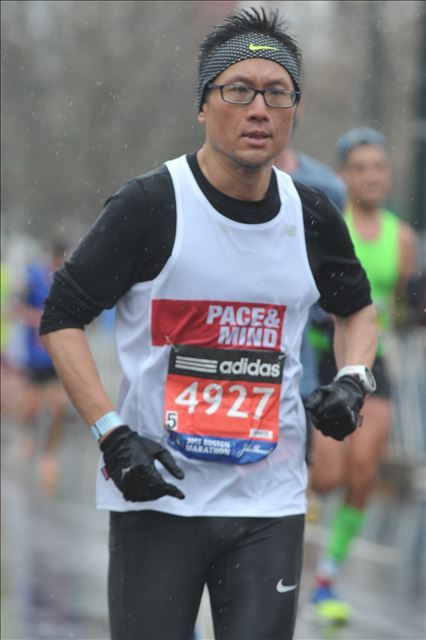
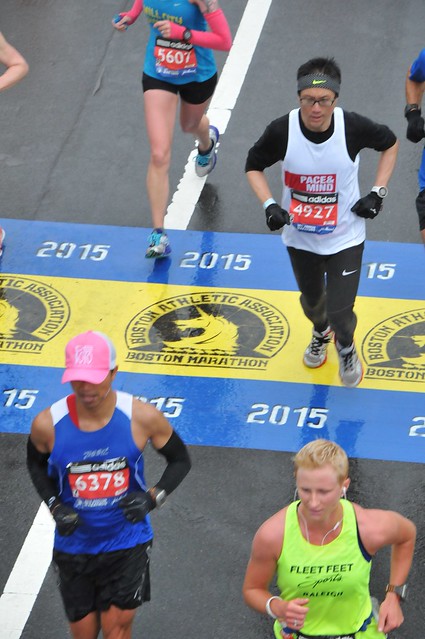
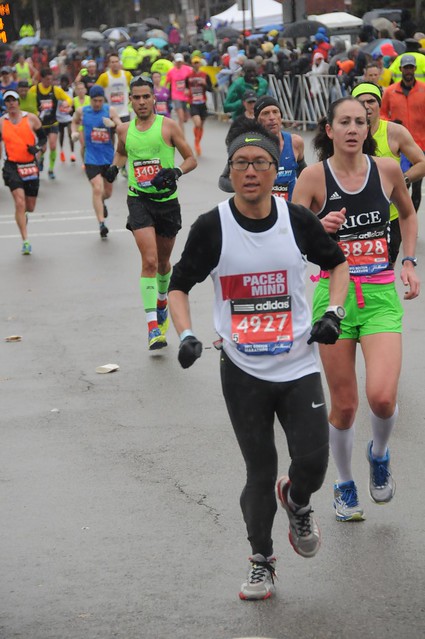
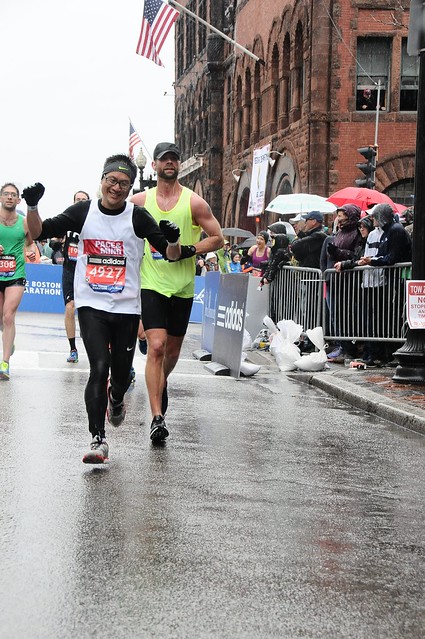
My bib, 4927, put me in the fifth corral and for the first Boston, I was intending to race. The 2011 edition saw me put down a 3:29 with a reasonable, fun-run effort, but this time I was bringing fitness to the start line. I was also bringing in some niggles.
The race plan had me attempting a sub 3 hour marathon. I had that on back of my mind, but if there's something I've learned, it's to listen to the body and effort. What I've been telling everyone was "I want to run a strong marathon." On my right wrist, I put on a 3:05 pace band. In my conversation with Lee on the bus, I told him, "I want to run strong and run a sub 3:10," which would be a near slam-dunk BQ. In my head, I wanted to end the marathon strong after conquering the hills of Newton.
1-5K: Hopkinton
A few minutes after the gun went off, we were flying down the hill and I was managing a controlled descent. While doing that first kilometre, I was doing a check of my foot and my upper hamstring (both were sore), but it was a pinch of my hamstring right above the knee that spoke up. I kept it easy, though, hitting the first kilometre in 4:22 or right around the 3:05 pace. Along the side, runners were taking a bathroom break and I joined in the second kilometre, which gave me a second kilometre of 4:40.
I knew that runners I had been seeded with were around the 3:02 and 3:03 range, so the crowd was going at a quick clip, but I could never really get a tune in for pace. As it turns out, we were taking the first 5K quite conservatively. Besides, the leg was still feeling blah and I didn't feel as bouncy as I thought. "Warm up for 5 miles," I thought, knowing that I have the legs for long distances and at times, it never feels right until 8K in.
Boston, I thought a few times, I'm really running Boston. The decision to dress for the end of the race and not the beginning was one I was starting to regret. I had worn tights, a long sleeve and a singlet over that. Underneath it, I had a pair of light armwarmers. I wore gloves and a headband instead of a hat or visor, a decision I came to regret later.
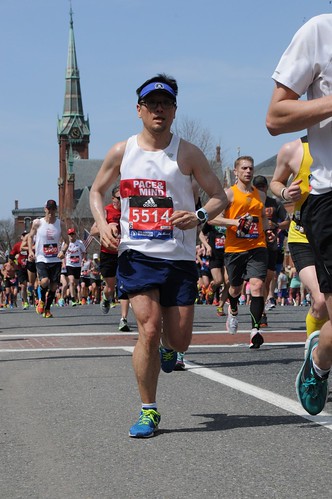
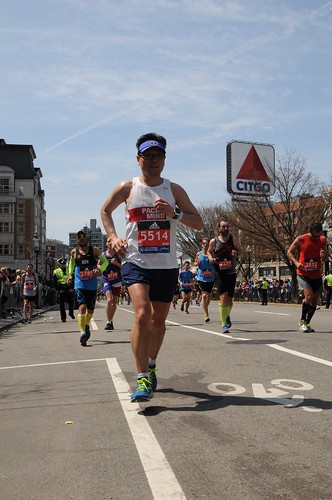
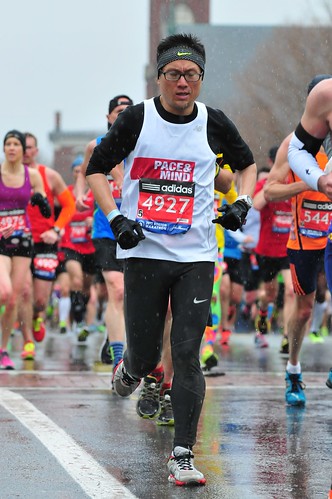
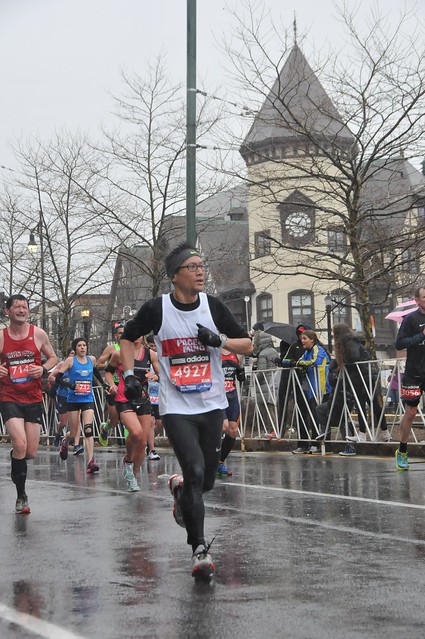
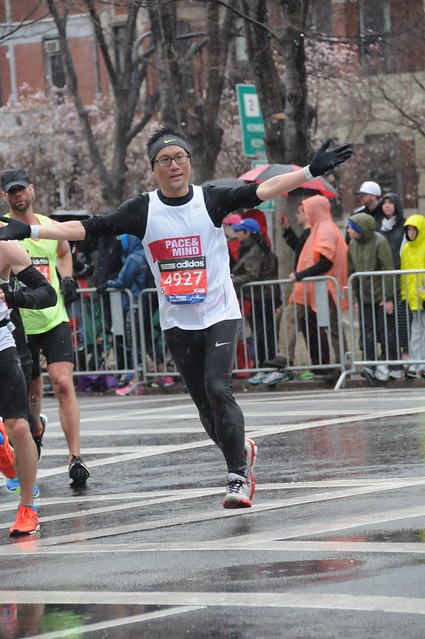
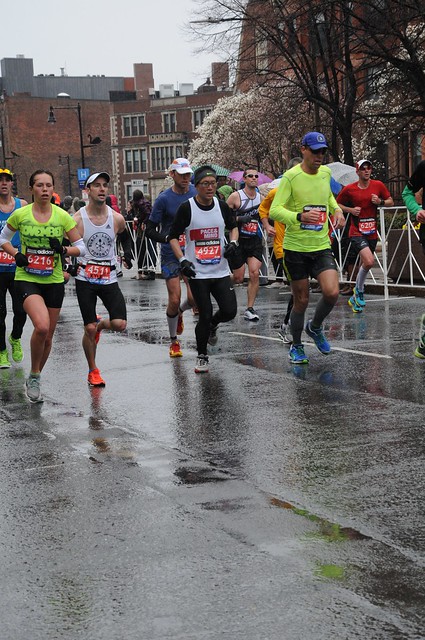
This is me later in the race, on Beacon Street. The picture captures the rain. Oh I hate rain.
We exited Hopkinton and into Ashland with me finally hitting a split around coach's plan -- a 4:12. It didn't feel hard so I went with the flow to see how the day would turn. It was still early.
6K-10K: Ashland to Framingham
I had hit the 5K mark well slower than the pace I needed to, but I remembered a lot about how I ran CIM in December. I put zero pressure on myself and ran it by feel and it netted me with a great run. At the same time, I was listening to how the running felt and it was a heavy feeling. I was babying my stride knowing that the niggles had not worked their way out of the body.
By the time I reached the comfort 8K mark, I had put down a 4:13, but also a few 4:18s and 4:20s. It felt like the good pace to take. The splits didn't concern me much.
Besides, the wind picked up and the rain, well, that started too.
11K-15K: Framingham to Natick
We exited Framingham and into Natick and by then, we were also battling the elements. I had torn off the arm warmers and rolled up the sleeves. The road was still fairly packed with runners and if I needed at this point to draft or pace with other runners, I could, so I continued to run by feel. A lot of my road races that I do with teammates, I run silently with them but the past three marathons, I've run them basically solo. I grew to realize the advantages of running with a partner -- you don't have to talk but you share a plan. Today, I felt like the plan was to run 'strong', whatever that pace felt like, and run within the limits of where my legs wanted to take me.
Besides, all of my training partners were doing different things today. Erin was using today as a training run so she started off slower. Randy was chasing a faster time and was in another corral. And Andrew was cheering somewhere in the final 4K.
The rain, I won't lie, is not my favourite weather. It may be more that I wear glasses when running and there's not much you can do to combat raindrops accumulating on your lenses. Runners with glasses can identify but not being able to really see the course can start to have an impact on your perception and feel for the road. When you are trying to strain to see where your footfalls land, your running form changes. I usually wear hats when it rains as it shields you somewhat but for some reason today, I felt that a headwind would drive rain into my face anyways.
So into the rain, it would be. With every bout of rain, I found it hard, literally, to focus.
But oh well, it's Boston, and a little headwind and rain ain't stopping me.
16K-20K: To Wellesley
I really couldn't really see my watch/paceband in the rain, but the splits I do recall made me think I was making good headway into my 3:05 "strong" marathon. The Natick to Wellesley stretch was a good time for me to try to open up, but my legs settled for anywhere from 4:18s to 4:25s. Still, I didn't see any red flags when it came to my running. Today, I felt, I could make it to the hills intact.
Wellesley is an impressive portion of the race. It signals a few key points in the race. First, it's where you'll find the Scream Tunnel, which I'll describe as a wall of sound you can hear hundreds of metres out. Then you enter into the town where the crowds are just spectacular. You also hit the half way mark, obviously a crucial part of the race. And it's into Wellesley and exiting Wellesley where you get a chance to taste the hills that are to come.
And it went as billed. I ran through the tunnel in awe of the noise. I ran up the subsequent hills, testing my fitness. I ran toward the halfway mark, knowing I was now closer to Boston than to Hopkinton.
I hit the half way mark in 1:32:10, and I remember seeing the number, thinking "okay, today it'll be okay -- lets get past Newton first."
21K-25K: Wellesley to Newton
On to Wellesley the terrain turns into rolling, with smaller inclines. I just ran by effort and while the wind and rain continued, I was starting to think that it was a good idea to dress for the cold. My gloves were soaked by this point from a few miscues at water stops and my tights were water logged, but I knew everyone else was having the same problem.
The fueling plan was going well -- I had my usual gel every 8K. I was taking water and Gatorade at the stops and felt the course was well managed. The crowds weren't out in full force but the citizens were definitely supportive.
We plunged down the final hill before entering the Newton area. I knew I was banking effort at this time, but was able to nail down a 4:11K.
One of the first surprises at Newton was a contingent of Parkdale Road Runners, who were there to cheer there own. My friend Angela was on the course, and I saw her just as she was yelling my name. I blew a kiss their way as we started to make our way to the first of four hills. Over the next five kilometres we'd hit two of the hills.
I had forgotten much about the Newton hills until now but the first one was in front of us. It was a long steady climb, as much as a kilometre. I just focused on the stride and made sure not to push myself to locomotive mode.
The second hill starts about a mile after you crest the first one, and is preceded by a downhill, enough so you can recover well. I think the hills are built with enough recovery to attack them a little harder, unlike the Around the Bay hills, which are more of true roller variety.
After the second hill, I hit the 30K mark in 2:12:10, well within my comfort pace. I kept on thinking about when Heartbreak would arrive.
31K-35K: Newton to Boston College
The third hill was merely a small bump in the road, but by the time we hit Heartbreak, around the 33-34K mark, I was thanking my coach for all the hills he'd put in the interval workouts, where we'd be cresting hills at tempo or interval pace.
During these efforts, even with the wind and rain, I was making my way up while other runners slowed. I wasn't going too fast but I felt I was revving up the engine, ready for the final stage of the race.
I crested Heartbreak while the rain fogged my glasses and looked at the rest of the course and I could see the course turn into the Boston College area. The crowd was much thinner than I'd remember, but I focused on what coached wanted. He wanted us to have energy for the end
The last three seasons of training had seen me hitting the marathon course three times and never really hitting the wall. It's an amazing feeling knowing you can make it well past the 32K, even 35K mark without running out of gas. I turned around a 4:13 35K and knew I had energy to run home with pace. If I could only see the road through the droplets on my glasses.
36K-40K: Boston College, Brookline, Boston.
What felt like a blister started to form under my left foot, and as I ran toward Beacon Street, I knew this was time to take advantage of the downhill course. If that was the worst of my worries, I'd take it. I resumed a faster pace, starting to hit the 4:22/4:23s. I knew at this point that I was going to finish this race the way I wanted it to. The rain, which had been falling for quite a while, was not going away, so it was a little harder to enjoy the experience. I remember in 2011 how I ran this portion harder and how great that felt and longed for that.
At Boston College.
My teammate Andrew told me he'd be somewhere 3-4K before the end, so around the 38K mark, I started to look left and right. The scanning, combined with my blurry field of vision, made for interesting running. I concluded that he had decided to regroup with a larger group of friends -- they had said they'd be at Kenmore Square, around a mile out from the finish and around the Citgo sign.
Nevertheless, the pace was still fine and my legs had cooperated so far. No way I was stopping.
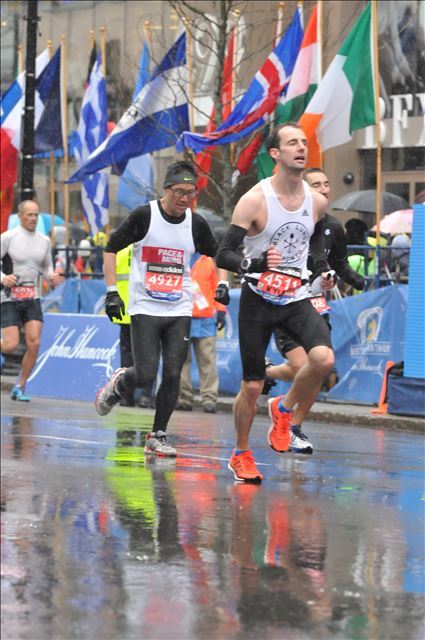
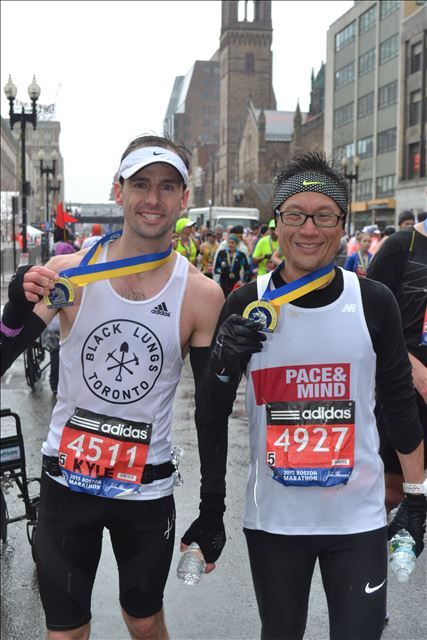
With about 2K to go, I felt a tap on my shoulder. It was my friend Kyle, who was a Blacktoe teammate last year. He now trains with the Black Lungs and told me he ended up in the medical tent a ways back and was running slower to the finish. With a few traded words, we agreed that'd we'd run together, reminding ourselves that we were here at The Boston Marathon.
So both of us ran, scanning the crowds for our friends. His wife was among them as was C. along with Pace and Mind and Blacktoe friends.
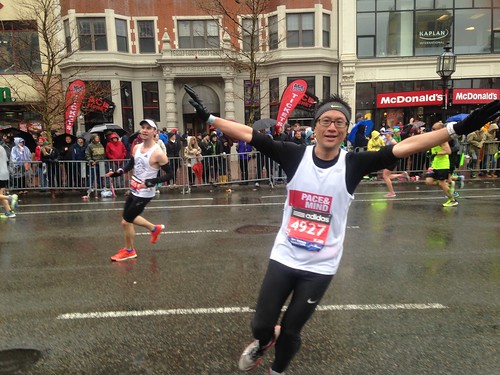
Kyle spotted them first, and with a few split seconds, I knew we just had to swing by. I'll let the pictures tell the story.
One of the best 20-30 second breaks I've ever taken. We doled out hugs, a kiss, finger points and encouragement to friends, while posing for a picture before being sent away. I shouted at my teammate Andrew that next year he'd be on the course withe me. These guys had seen me through many seasons, witnessed my comeback, ran many miles with me, made me a better runner. If I was to stop, it was for them.
We continued running and took an easier pace. We hollered at the crowd, relishing the moment. I thought, as we went under the bridge as we approached Hereford, that it was at the same point where the race was halted in 2013. That 2013 April day made me want to come back to Boston as soon as possible and now I was running pass that mark, and about to make the series of turns.
It meant something.
We turned right on to Hereford and I heard my friend Julie shout my name. I waved, then turned left on to Boylston and gave the biggest smile. I was here.
And there was the finish. There was no stopping me now. All the years I wanted to get back here. All the training runs that got me my Boston qualifer, all the fitness that got me three Boston qualifying runs last year. It was all for this moment, and I wasn't going to let that slip.
We yelled. We waved. We screamed. We said how cool it was. It was.
If Kyle and I could have run it slower, I'm sure we would have. His hamstring was pulling, and with 100 metres to go, my left calf gave a little. He looked back, thinking I was giving him room to finish ahead of me, but I limp/ran to the finish a few steps behind.
I smiled, thinking how ridiculous it was to run 26.14 miles to have to have my calf complain at the end. But that was no real matter. The finish was steps away and at some point, I would have to stop my dream run that I didn't want to end.
41: 4:50
42: 4:36
42.2: -- 4:37 pace
42.2K: 3:07:32 (10:26 for 2.2K or 4:44K pace)
Final pace: 4:26
I finished my 30th marathon and third Boston in 3:07:32. Days later, friends asked me that I missed a 'PB' by a few seconds (not knowing my PB was in the 3:02:54 range) but even for the chance to choose between the third or second fastest marathon, I absolutely have no regrets.
This race completes the comeback. It tells me that in 24 months, you can work and realize a dream. I must have run 8,000 kilometres to get back to Boston, endured two Polar Vortex winters, but I choose to remember how the journey took me to new places. I learned to run, I became a better runner, I made a lot of amazing friends who cheered me on race day. I learned patience, resilience and strength. Boston will come again and -- if all being equal -- the truth is that I'm not stopping here.
I'm coming back in 2016.
I'm coming back because on Monday I qualified for Boston at Boston.
In Massachusetts, on Patriot's Day, there is no stopping.